
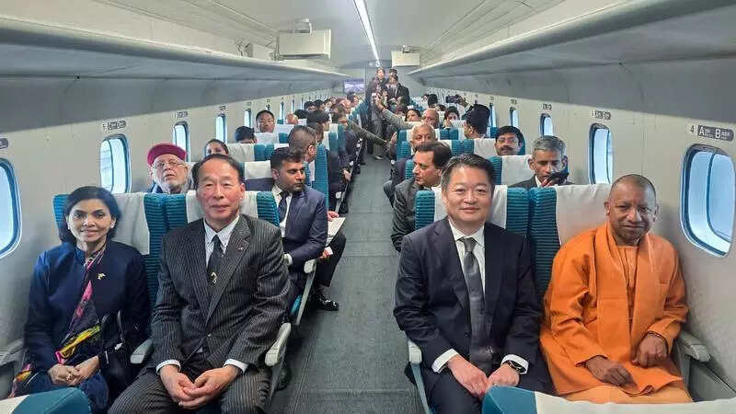
When visuals of Yogi Adityanath SCMAGLEV ride surfaced online, they quickly grabbed national attention. The Chief Minister was seen traveling at an incredible 501 km/h aboard Japan’s futuristic magnetic levitation train.
The ride wasn’t just a symbolic moment, it was aspirational. Sharing his experience on X, Yogi praised the journey as “smooth and remarkably stable even at extraordinary speed,” highlighting Japan’s long-term commitment to technological innovation. The event has sparked conversations about what such advanced transport technology could mean for India, particularly for Uttar Pradesh, which is rapidly modernizing its infrastructure.
Inside the Japan SCMAGLEV Train Experience
The train Yogi boarded wasn’t an ordinary bullet train. It was Japan’s cutting-edge SCMAGLEV, short for Superconducting Magnetic Levitation.
Unlike traditional high-speed rail, this Superconducting Magnetic Levitation train floats above the tracks using powerful magnetic forces. There are no wheels in contact with rails once top speed is reached. The result? Minimal friction, unmatched speed, and exceptional stability.
The demonstration took place at the Yamanashi Maglev Test Line, a testing corridor that has become a symbol of Japan’s engineering ambition.
As the onboard display board touched 501 km per hour speed, Yogi captured the milestone — a photograph that quickly went viral.
What Makes Magnetic Levitation Technology Revolutionary?
To appreciate the significance of the ride, it helps to explore the science and technology behind the SCMAGLEV train.
1. Magnetic Levitation Technology Explained
Maglev trains use:
- Superconducting magnets
- Repulsive magnetic forces
- Aerodynamic engineering
This magnetic levitation technology eliminates wheel-track friction, enabling speeds far beyond conventional rail systems.
2. Stability at 500 km/h
At over 500 km/h, even slight vibration can cause discomfort in traditional trains. Yet Yogi emphasized how stable the ride felt — reinforcing Japan’s reputation for precision engineering.
3. Long-Term Infrastructure Thinking
Japan’s investment in the Japan SCMAGLEV train reflects decades of research, billions in funding, and a commitment to future-ready transport.
Yogi Japan Visit: A Learning Mission
The Yogi Japan visit was not just ceremonial. Uttar Pradesh has been aggressively expanding its infrastructure network — expressways, metro corridors, and airport connectivity.
By experiencing the Superconducting Magnetic Levitation train firsthand, Yogi signaled a willingness to explore global best practices.
His social media post read:
“You can see that I was travelling at 501 km/h. Experienced Japan’s advanced SCMAGLEV train in Yamanashi… the ride was smooth and remarkably stable even at extraordinary speed, reflecting Japan’s commitment to innovation and long-term infrastructure excellence.”
The ride taken by Yogi Adityanath became more than just a photo opportunity it sent a clear message about technological progress and aspirations.
Can India See Bullet Train India Projects Like This?
India is already working on the Mumbai-Ahmedabad bullet train corridor. But the question remains: could India one day adopt high-speed train technology comparable to Japan’s maglev system?
Currently, India’s bullet train uses Shinkansen-based technology. Maglev, however, is a different leap altogether.
Challenges:
- High cost of infrastructure
- Land acquisition
- Technical complexity
- Energy requirements
Opportunities:
- Reduced travel time drastically
- Economic corridor development
- Global investment attraction
- Positioning India as a tech-forward nation
The Yogi Adityanath SCMAGLEV ride subtly aligns with Uttar Pradesh’s ambition to become a trillion-dollar economy contributor.
Uttar Pradesh Infrastructure Vision
Under Yogi Adityanath, Uttar Pradesh has invested heavily in:
- Purvanchal Expressway
- Bundelkhand Expressway
- Jewar International Airport
- Metro expansions in Lucknow and Kanpur
The state’s Uttar Pradesh infrastructure vision emphasizes connectivity as a driver of economic growth.
Experiencing the Japan SCMAGLEV train reinforces the idea that transport innovation is central to long-term development.
Why the 501 Km/h Moment Matters
The visual of the digital display showing 501 km per hour speed is powerful.
It symbolizes:
- Speed of progress
- Confidence in technology
- Global collaboration
The Yogi Adityanath SCMAGLEV ride highlights that Indian leadership is observing, learning, and potentially adapting cutting-edge systems.
In a country where millions rely on railways daily, imagining such speeds feels almost cinematic.
Innovation in Transport: India’s Next Frontier
Globally, nations are competing in innovation in transport:
- China has advanced maglev prototypes
- Japan is preparing its Tokyo–Nagoya maglev corridor
- European countries are upgrading high-speed rail
For India, the focus remains on scalability and affordability.
The Yogi Adityanath SCMAGLEV ride sends a message that high-speed mobility is not a distant dream — it is an evolving conversation.
Public Reaction and Symbolism
Social media reactions ranged from excitement to curiosity.
Many users praised:
- The global exposure
- The aspiration for similar technology in India
- The CM’s visible enthusiasm
Others debated:
- Cost feasibility
- Applicability in Indian terrain
- Priority versus basic rail modernization
But regardless of viewpoint, the Yogi Adityanath SCMAGLEV ride achieved one thing — it made high-speed infrastructure a trending national topic.
The Human Moment Behind the Technology
Beyond the policy angle, there was something refreshingly human about the visuals.
A Chief Minister watching a speed display cross 500 km/h, taking photos like an excited traveler — it resonated.
Innovation isn’t just machinery.
It’s an inspiration.
The Yogi Adityanath SCMAGLEV ride reflects a leader witnessing what the future could look like — and perhaps imagining how it could translate back home.
Could Uttar Pradesh Host High-Speed Corridors?
Uttar Pradesh’s dense population and strategic geography make it a potential hub for high-speed corridors connecting:
- Delhi
- Lucknow
- Varanasi
- Kanpur
- Prayagraj
While maglev adoption may still be distant, incremental improvements in high-speed train technology are realistic goals.
Japan’s Commitment to Excellence
Japan’s Superconducting Magnetic Levitation train is not just about speed. It represents:
- Long-term planning
- Engineering precision
- Infrastructure as national identity
The journey highlights this philosophy a reminder that building world-class infrastructure takes time, planning, and long-term commitment.
Speed as a Symbol of Aspiration
The journey will be remembered as a standout moment of his Japan visit, but its true importance lies in the message it sends about innovation and progress. It highlights:
- India’s openness to learning from global advancements
- Uttar Pradesh’s ambitious infrastructure plans
- The power of technology to inspire forward-thinking policy
As India continues to modernize its rail network, experiences like this serve as both motivation and a benchmark. Seeing the train reach 501 km/h is undeniably thrilling—but the bigger question is: how quickly can India move toward this future?
If the enthusiasm from this ride translates into sustained policy focus and investment, India’s journey toward next-generation transportation could accelerate faster than many expect.
Stay connected with newsnarada.in – Messenger of Truth.