
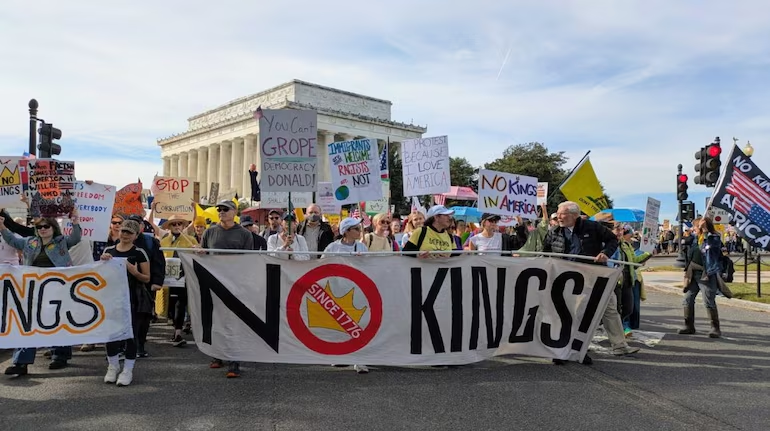
On March 28, 2026, something remarkable happened across the United States. In small towns and sprawling cities, on college campuses and in suburban cul-de-sacs, millions of Americans stepped away from their daily routines and took to the streets. From Times Square in New York to the steps of state capitols across all 50 states, the message was unified and unmistakable: America does not bow to kings. This wave of America Protests reflected a powerful nationwide call for democratic values and accountability.
Organizers reported that more than 8 million people participated in what is now being called the largest single-day demonstration in American history the third wave of the ‘No Kings’ movement that has become the defining symbol of public opposition to the Trump administration’s second term. At a time when civic trust in government is being openly questioned, the sheer scale of turnout sent an undeniable signal.
So what exactly is the ‘No Kings’ movement? What are protesters angry about? And why does it matter? This blog breaks it all down.
What Is the ‘No Kings’ Movement?
The ‘No Kings’ movement is a grassroots protest coalition that first organized in June 2025 initially sparked by President Trump’s decision to hold a large military parade in Washington, D.C., on his birthday. The symbolism was hard to miss for critics who saw the parade as another sign of the administration’s authoritarian drift.
That first protest drew an estimated 5 million participants the largest of its kind at that time. A second wave in October 2025 drew 7 million, making it the biggest political demonstration in American history up to that point. Now, the third round has shattered that record again, with organizers reporting over 8 million people marching across more than 3,300 events in all 50 states and several countries, including protests in Canada, Australia, Mexico, and parts of Europe.
The movement draws its name from a core democratic principle that the United States was founded in opposition to monarchy and concentrated power. As one protest organizer put it, standing up and saying ‘there are no kings in America’ is not a partisan act. It is, in their words, the most patriotic thing you can do now more than ever.
Why Are Millions of Americans Taking to the Streets?
The protests are not anchored to a single grievance. Instead, they reflect a broad and growing frustration with multiple policy decisions that critics say are threatening democratic norms, civil liberties, and the everyday lives of ordinary Americans.
Immigration Enforcement and the Deaths in Minnesota
Perhaps no issue has generated more raw emotion than the deaths of Alex Pretti and Renee Good two American citizens killed during a federal immigration crackdown in the Twin Cities in January 2026. Good was fatally shot by an Immigration and Customs Enforcement officer, while Pretti was struck multiple times when two Customs and Border Protection officers opened fire. The incident, which targeted Somalian-American residents, drew widespread condemnation and, for the first time, turned a significant portion of politically moderate Americans toward active protest.
It is why organizers chose St. Paul, Minnesota the state capital as the flagship protest site for March 28. An estimated 100,000 people gathered there, where rock legend Bruce Springsteen performed his tribute song ‘Streets of Minneapolis,’ telling the crowd: ‘They picked the wrong city.’ Minnesota Governor Tim Walz also addressed the rally, pushing back against characterizations of protesters as radicals and noting that this was no time for silence.
The War in Iran and Rising Gas Prices
Since the United States and Israel launched airstrikes on Iran on February 28, 2026, the war has become a defining issue for protest movements. Dozens of demonstrations had already taken place in the weeks leading up to March 28. Polling from Reuters/Ipsos, the Associated Press, and Fox News all suggest the conflict has hurt Trump’s approval ratings among Democrats and independents and for the first time in years, foreign policy has moved to the top of voters’ concerns.
One of the most tangible consequences of the Iran conflict has been a spike in gas prices an issue that cuts across party lines. Senator Bernie Sanders drew a direct parallel at the St. Paul rally, connecting the current war to past conflicts in Vietnam and Iraq, and accusing the administration of repeating the same time-worn mistakes that have defined American foreign policy for decades.
Concerns Over Democratic Norms
Beyond specific policy flashpoints, many protesters expressed deeper anxiety about the direction of American democracy. The Treasury Department’s announcement that Trump’s signature would appear on US currency an unprecedented move for a sitting president prompted Democratic Senator Kirsten Gillibrand of New York to announce legislation blocking such action. At the Washington D.C. march, crowds chanted pro-democracy slogans and held signs demanding accountability. Even elderly residents outside a high-rise assisted-living facility in suburban Maryland held signs reading ‘Resist tyranny’ and ‘Dump Trump.’
Who Is Organizing the ‘No Kings’ Protests?
The movement is a coalition of progressive and civil liberties organizations, including Indivisible, Public Citizen, MoveOn, the American Civil Liberties Union (ACLU), the National Action Network, and the 50501 movement. The last of these which originally called for 50 protests in all 50 states on a single day has since expanded into an ongoing national organizing effort.
While the organizing groups lean left, the sentiment on the ground was more varied than any party label might suggest. Attendees in cities like Dallas and Los Angeles described their motivation in deeply personal terms concern for their children’s future, anger at economic hardship, and a desire to defend democratic institutions. ‘One thing I’ll give Trump credit for is mobilizing the dissenters,’ one Dallas protester said. ‘There comes a time when you can’t stand by and be silent anymore and that time is now.’
What Happened on March 28, 2026?
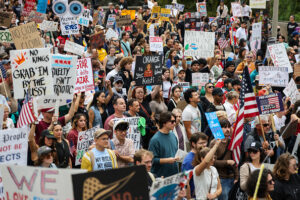
The day unfolded across thousands of locations simultaneously. The NYPD confirmed that tens of thousands marched across all five New York City boroughs without a single protest-related arrest. Crowds crossed Memorial Bridge in Washington, D.C. In Los Angeles, thousands rallied. In Austin, Texas, an ice sculpture of a crown was placed at the protest site and left to melt throughout the day a powerful visual metaphor for the movement’s message.
Not all events were peaceful. In Dallas, clashes broke out between No Kings marchers and counterprotesters, including groups associated with far-right organizations. In Portland, Oregon, some arrests occurred outside an ICE facility. Near the Roybal Federal Building in Los Angeles, the Department of Homeland Security reported two federal officers were hit with cement blocks. However, the overwhelming majority of the more than 3,300 events nationwide passed without incident.
The White House dismissed the protests as ‘Trump Derangement Therapy Sessions.’ The administration has not wavered on its policies. Protest organizers, for their part, say the movement will continue to grow.
Why the ‘No Kings’ Movement Matters
Whether or not one agrees with the protesters’ politics, the scale and consistency of the ‘No Kings’ movement is historically significant. Time and again, sustained mass mobilization has proven to be one of the few forces capable of shifting the course of national policy. If organizer estimates are accurate, the three rounds of protests 5 million, 7 million, and now 8 million participants represent a mobilization of civic energy unlike anything the United States has seen in modern history.
Mass protests have historically shaped policy outcomes. The civil rights marches of the 1960s contributed to landmark legislation. The women’s marches of 2017 helped reshape political participation. It is too early to know what legislative or electoral consequences the No Kings movement will produce but its trajectory suggests the opposition to the Trump administration’s second term is far from passive.
For the millions who showed up on March 28, 2026, the message was both simple and profound democracy is not a spectator sport. As one New York protester put it, echoing the country’s founding spirit: ‘We fought against having kings and we fought for freedom. We’re just doing it again.’
The Road Ahead
With three rounds of protests now complete and participation growing each time, the No Kings movement shows no signs of slowing down. Organizers have pointed to real-world political consequences including the passage of the Epstein Files Transparency Act, which became law one month after the October 2025 protests as evidence that sustained public pressure can force accountability.
The protests have also spread internationally, with demonstrations reported in Canada, Australia, Mexico, and across Europe on March 28. The global reach suggests that what is happening in America is being watched and felt well beyond its borders.
What ultimately defines this movement will depend on what comes next in the courts, in Congress, and in future elections. But this is a time in American history where the pace of change is being set not by politicians alone, but by ordinary citizens who refuse to stay home. America, it appears, has not forgotten what it means to stand against the concentration of unchecked power.
Source: Based on BBC News reports on the ‘No Kings’ protests and the ongoing America Protests movement.