
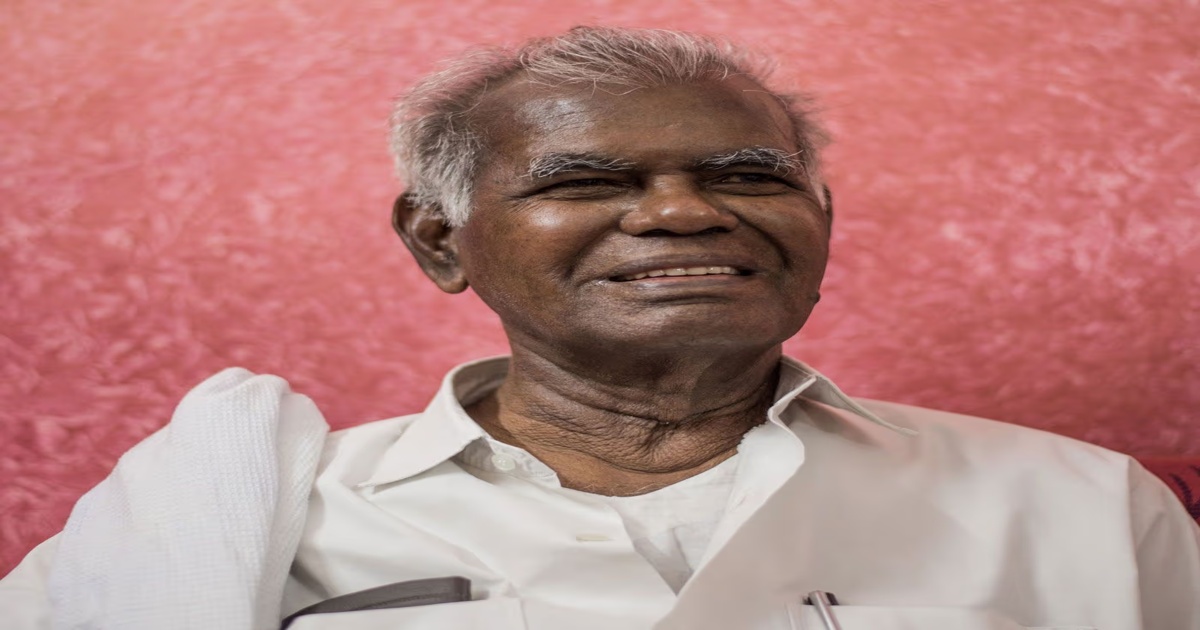
A Century of Purpose
In a world where most people search their entire lives for meaning, R. Nallakannu was born with purpose already burning in his chest. On February 25, 2026, Tamil Nadu and indeed all of India lost one of its most extraordinary sons. He was 101 years old. But the number that truly defines him is not his age. It is the eighty-three years he spent fighting, without rest and without reward, for the rights of farmers, laborers, and the voiceless. He lived not for himself, but entirely for others. And that is a life worth studying, celebrating, and being inspired by.
Early Life: Roots in Humble Soil
Ramasamy Nallakannu was born on December 26, 1924, in Srivaikuntam, a small town in the Thoothukudi (Tuticorin) district of Tamil Nadu, as the third of ten children in an agricultural family. Though his family was reasonably comfortable, the world outside their home was anything but. British colonialism gripped India. Poverty, caste oppression, and the exploitation of workers were facts of daily life.
Even as a child, young Nallakannu could not ignore the suffering around him. As early as the 1930s, during the Harvey Mills strike, he was already helping distribute rice to striking workers’ families. At just twelve years old, he campaigned for the Indian National Congress during the 1937 provincial polls. His conscience was awakened long before adulthood.
When he moved to Madurai to study at The Hindu College, his worldview deepened. He immersed himself in socialist writings and was drawn to the Communist ideal that every human being deserves dignity, equality, and justice regardless of caste, class, or creed. In 1943, at just seventeen years of age, he made the decision that would define his entire life: he joined the Communist Party of India (CPI).
The Freedom Struggle: Fearless Against Colonial Power
Nallakannu did not just join the freedom movement; he threw himself into it completely. During the Quit India Movement of the 1940s, he actively mobilized youth against British rule. His defiance was so bold that he was expelled from college for his activism. He did not flinch. No degree, no comfort, and no safety were worth more to him than justice.
He moved to Chennai in 1944 to work for Janasakthi, the CPI’s Tamil-language newspaper, writing articles that exposed wartime hoarding, economic exploitation, and the injustices of colonial governance. He organised strikes, led rural agitations, and built class consciousness among peasants across Tamil Nadu at a time when doing so meant risking imprisonment or worse.
The repression came. After India gained independence, the Communist Party was briefly banned. On December 20, 1949, Nallakannu was arrested and implicated in the infamous Nellai Conspiracy Case. He was sentenced to life imprisonment and endured unspeakable torture during his time in Madurai Central Prison, including having his moustache burnt with cigarettes by guards. He served seven years and walked out of prison with his spirit unbroken.
That is the measure of a man.
A Life of Struggle After Independence
Freedom from British rule did not mean freedom from injustice, and Nallakannu knew it. After his release in 1956, he devoted himself entirely to the struggles of ordinary Tamil people farmers losing their land, agricultural labourers denied fair wages, and communities crushed under the weight of caste discrimination.
He served as the State Secretary of the CPI’s Farmers’ Union for twenty-five years, travelling across the districts of Thoothukudi and Tirunelveli, organising grassroots movements for tenancy rights, fair crop prices, and protection against exploitation. He led the CPI’s Odukkapattor Vazhvurimai Iyakkam (Oppressed People’s Movement for Right to Live), a powerful campaign that gave hope to some of Tamil Nadu’s most marginalized communities.
He was a fearless fighter against untouchability. When caste riots erupted in southern Tamil Nadu, Nallakannu undertook a padayatra (march on foot) through riot-torn areas to restore peace even after his own father-in-law was murdered in the violence. He walked through the grief. He kept going.
He undertook multiple hunger strikes in his lifetime, some lasting more than twenty days, to draw attention to farmers’ rights and workers’ issues. His body bore the cost. His will never wavered.
Leadership Within the CPI
From 1992 to 2005, R. Nallakannu served as the State Secretary of the Communist Party of India in Tamil Nadu a position he held for thirteen years. During this period, as India rapidly liberalized its economy and worker protections were being eroded, he steered the party through some of its most challenging political phases. He trained cadres, strengthened party branches, and kept the CPI anchored in its core mission of serving the poor.
He was also a member of the CPI’s National Executive Committee, meaning his voice shaped party policy at the national level. He contested Assembly elections in 1967, 1977, and Parliamentary elections in 1999 but he was famously clear-eyed about his own purpose. He once stated that public struggle, not electoral victory, was his primary mission. He meant it.
He also championed the rights of prisoners, advocating powerfully for access to education inside jails believing that even those behind bars deserved the chance to learn and grow.
Achievements That Will Outlast a Lifetime
The legacy of R. Nallakannu is not found in personal wealth or political power. It is found in the lives he changed and the causes he advanced.
He successfully campaigned for a landmark legal ban on sand mining in the Thamirabarani River, fighting and winning the case at the Madurai High Court in 2018 at the age of 93. He authored more than ten books on politics, social justice, and the communist movement in Tamil Nadu, leaving behind a written record of both his ideas and his times.
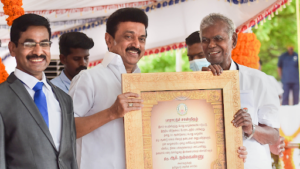
He was honored with the Ambedkar Award in 2007–08, the Sahayogi Puraskar in 2007, the Gandhian Award for Social Service in 2008, and the prestigious Thagaisal Thamizhar Award in 2022 presented by Chief Minister M.K. Stalin on Independence Day. He received ₹10 lakh in prize money. He donated every rupee of it to the Chief Minister’s Public Relief Fund without hesitation. He was recognized by the Vice President of the People’s Republic of China during a visit to Beijing as an acknowledgment of his standing as an international figure in the global left.
He was married to Ranjitham Ammal, a retired schoolteacher and headmistress, in an inter-religious marriage that itself was a quiet act of defiance against the caste system he had fought his whole life. She financially supported the family while he served the people on a minimal party allowance. Together, they raised two daughters.
He lived simply. He died without personal wealth. He gave everything away.
Passing of a Giant: February 25, 2026
Nallakannu was admitted to the Rajiv Gandhi Government General Hospital in Chennai on February 1, 2026, after severe respiratory distress. For twenty-four days, a multidisciplinary team fought to save him. Chief Minister M.K. Stalin and leaders from across the political spectrum visited the hospital. On February 25, 2026, at 1:55 p.m., he breathed his last, peacefully, surrounded by a nation’s grief.
He was 101 years old. He had not wasted a single one of those years.
What We Can Learn: The Lessons of Nallakannu’s Life
The life of R. Nallakannu teaches us things that no classroom can fully convey.
It teaches us that purpose is more powerful than comfort. He gave up college, career, and personal prosperity to serve others — and he never regretted it.
It teaches us that setbacks do not define us. Imprisoned, tortured, and politically defeated, he walked forward every single time.
It teaches us that integrity is a choice we make every day. When awards brought him money, he gave it away. When people collected funds in his honor, he returned them.
It teaches us that age is no barrier to impact. He won a court case for river conservation at 93. He received Tamil Nadu’s highest civilian honor at 97. His centenary celebrations in December 2024 were inaugurated by the Chief Minister himself.
Most of all, his life teaches us that a life lived for others is the only life truly worth living.
Farewell, Ayya
Tamil Nadu has lost a father figure. India has lost a freedom fighter. The poor and the farmer have lost their most unwavering voice.
But R. Nallakannu himself would tell us not to mourn too long. He would tell us to get up, go to work, and fight for the person beside us who has less. He would tell us that the struggle continues, and that the best tribute we can offer is not a tear, but a deed.
Rest in peace, Ayya Nallakannu. You lived 101 years. Every single one of them mattered.
Stay connected with newsnarada.in – Messenger of Truth.