
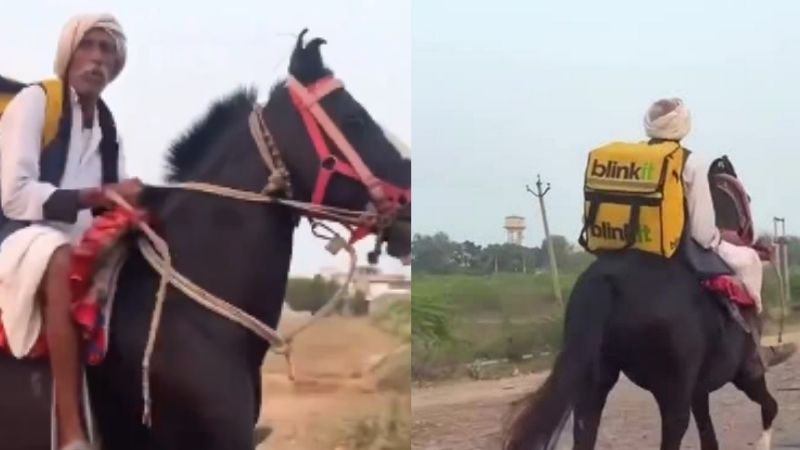
The Blinkit horse delivery viral video has taken the internet by surprise — not because deliveries are unusual, but because of how this one was made. In an era dominated by high-speed bikes, GPS tracking, and 10-minute promises, an elderly man riding a black horse with a bright yellow Blinkit delivery bag strapped to his back has become the most unexpected symbol of modern India’s quick-commerce boom.
Yes, you read that right.
Not a two-wheeler.
Not an electric scooter.
Not a delivery van.
A horse.
And that’s exactly why the Blinkit horse delivery viral video is resonating so strongly across social media timelines.
Quick-Commerce Platforms: Speed Meets Street Reality
Over the past few years, quick-commerce platforms have reshaped urban lifestyles. Brands like Blinkit, Swiggy, and Zepto have turned instant gratification into an expectation.
Milk at midnight?
Groceries in 10 minutes?
Forgot toothpaste before the office?
Just tap and wait.
Across Indian cities, two-wheeler delivery workers with branded bags have become as common as traffic lights. The neon-colored delivery bags — especially the bright yellow Blinkit delivery bag — are instantly recognizable.
But the Blinkit horse delivery viral video reminds us that India is not just metros and motorbikes.
It is also dusty roads, open fields, and traditions that predate technology by centuries.
The Viral Moment in Rajasthan
The now-famous clip — widely shared as a Rajasthan viral video — shows an elderly man riding a black horse along the edge of a semi-rural road.
The setting is unmistakably non-urban:
- Green agricultural fields stretch on one side
- Scattered low-rise buildings dot the background
- A roadside signboard stands quietly
- Sparse traffic passes by
And in the center of it all — the rider.
Dressed in traditional Rajasthani attire with a turban wrapped neatly around his head, the man sits upright, holding the reins with practiced ease. The horse, decorated with a red bridle and saddle cloth, moves steadily forward.
But what truly grabs attention?
The bright yellow Blinkit delivery bag resting squarely on his back.
That single frame — tradition meeting tech — is what turned this into the Blinkit horse delivery viral video.
Why This Video Is More Than Just “Funny”
At first glance, many viewers laughed. Some called it “India 2.0 meets 1820.” Others joked that this is the “eco-friendly future of delivery.”
But beyond humor, the Blinkit horse delivery viral video highlights something deeper — the adaptability of India’s last-mile delivery ecosystem.
Quick-commerce is designed for speed. But speed doesn’t look the same everywhere.
In congested cities, it’s bikes weaving through traffic.
In gated societies, it’s electric scooters.
In semi-rural Rajasthan, maybe — just maybe — it’s a horse.
This moment challenges our assumptions about modernization.
Rural Delivery Innovation: A Practical Choice?
Could this be an example of rural delivery innovation rather than just a viral stunt?
In many parts of India:
- Roads may be uneven
- Fuel costs are rising
- Traffic conditions vary
- Accessibility differs dramatically
A horse in certain terrains could actually be more practical than a bike.
Historically, horses were India’s original transport technology. What we’re seeing in the Blinkit horse delivery viral video may not be backwardness — it may be contextual adaptation.
That’s what makes the clip so powerful.
It visually captures:
Tradition + Technology + Entrepreneurship.
The Face Behind the Viral Frame
The elderly delivery man in the video has captured hearts across platforms. His calm posture and dignified presence contrast sharply with the usual image of hurried riders racing against a delivery timer.
He isn’t rushing recklessly through traffic.
He isn’t honking impatiently.
He isn’t stuck in a gridlock.
Instead, he moves steadily — reins in hand — through open air.
In an age where delivery workers are often seen as stressed and overworked, the Blinkit horse delivery viral video presents a strangely poetic image.
But it also raises important questions:
- Is this an official delivery?
- Is it a promotional stunt?
- Or is it simply local adaptation?
Regardless, the visual impact is undeniable.
Swiggy and Zepto Riders vs. A Horse
Compare this scene to the usual sight of Swiggy and Zepto riders navigating urban chaos:
- Honking traffic
- Narrow lanes
- Deadline pressure
- App notifications
Now imagine replacing that with open fields and hoofbeats.
The contrast is cinematic.
And perhaps that’s why the Blinkit horse delivery viral video spread so quickly — it feels almost surreal.
Social Media Reactions: Laughter, Pride, Curiosity
The social media reactions have ranged from amusement to admiration.
Some users commented:
- “This is peak Indian jugaad.”
- “Sustainable delivery goals.”
- “Blinkit 10-minute delivery now in horsepower.”
Others praised the moment as symbolic:
“India’s digital revolution isn’t just urban.”
The humor is obvious. But beneath it lies pride — a recognition that quick-commerce platforms are penetrating even non-metro regions.
The Evolution of Last-Mile Delivery in India
India’s last-mile delivery journey has evolved dramatically:
- Bicycle couriers
- Motorcycles
- App-based two-wheeler delivery workers
- Electric scooters
- And now… possibly horses?
The Blinkit horse delivery viral video may represent a quirky footnote in this timeline, but it also symbolizes flexibility.
Technology doesn’t erase tradition — it integrates with it.
Quick-Commerce Platforms Expanding Beyond Metros
For years, quick-commerce platforms focused heavily on Tier 1 cities. But now:
- Tier 2 and Tier 3 towns are booming
- Rural demand is increasing
- Internet penetration is deeper than ever
The sight of a Blinkit delivery bag in rural Rajasthan reflects this expansion.
The Blinkit horse delivery viral video is proof that brand presence has reached new landscapes.
And those landscapes don’t always come with smooth asphalt roads.
Sustainability Angle: Horsepower vs. Fuel
In a world increasingly concerned with carbon footprints, the imagery of a horse delivering groceries feels almost symbolic.
No petrol.
No emissions.
No battery charging.
While clearly not scalable for cities, the visual in the Blinkit horse delivery viral video sparked conversations about sustainable delivery methods.
Could rural logistics adopt alternative transport models?
Is hyperlocal adaptation the future?
Tradition and Technology: India’s Unique Blend
India has always blended extremes:
- Ancient temples next to tech parks
- Bullock carts beside Teslas
- Handwritten ledgers alongside fintech apps
The Blinkit horse delivery viral video fits perfectly into that narrative.
An elderly man in a turban carrying a neon delivery bag isn’t a contradiction — it’s coexistence.
Why This Story Matters
Beyond virality, this moment reminds us:
- Quick-commerce platforms are penetrating deep into India’s geography.
- Innovation doesn’t always look futuristic.
- The face of delivery isn’t limited to young urban riders.
- Rural delivery innovation may take unexpected forms.
The Blinkit horse delivery viral video is funny, yes — but it’s also revealing.
It shows how digital India moves at different speeds in different places.
Final Thoughts: When Modern India Rode on Hoofbeats
The image of that elderly delivery man guiding his black horse along a quiet Rajasthani road while wearing a Blinkit delivery bag is more than a viral moment.
It is a metaphor.
A metaphor for:
- Adaptation
- Expansion
- Local ingenuity
- The meeting of centuries
The Blinkit horse delivery viral video reminds us that progress doesn’t always roar. Sometimes, it trots.
And in that rhythmic clip-clop of hooves, we hear something uniquely Indian — a country where the future doesn’t replace the past.
It rides alongside it.
Stay connected with newsnarada.in – Messenger of Truth.
Written by Tejas Dhanakoti| NewsNarada | Updated: February 24, 2026