
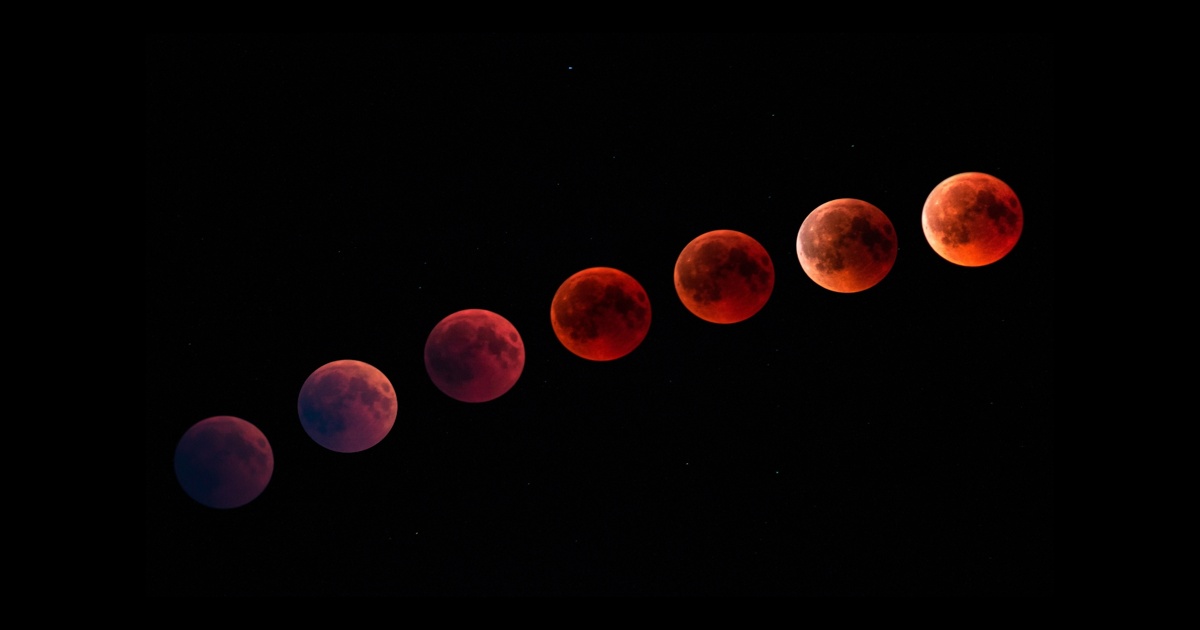
The total lunar eclipse Blood Moon will mesmerize skywatchers worldwide on March 3, 2026, making it one of the most anticipated astronomy events of the year. During this rare alignment, Earth’s shadow will completely cover the Moon, giving it a striking reddish glow that earned it the nickname Blood Moon.
In this article, we break down everything you need to know from the science behind the eclipse to how and where to watch, the key viewing times, and tips to fully enjoy this breathtaking celestial event.
What Is a Total Lunar Eclipse?
A lunar eclipse Blood Moon occurs when the Earth comes directly between the Sun and the Moon, blocking direct sunlight from reaching the lunar surface. Instead of disappearing entirely, sunlight that passes through Earth’s atmosphere bends toward the Moon, scattering shorter wavelengths and leaving redder hues to illuminate the lunar surface.
This phenomenon transforms the Moon into a deep coppery, orangish, or ruddy tone, a stunning visual effect that has inspired wonder and myth for centuries. Unlike solar eclipses, total lunar eclipses are safe to watch with the naked eye.
The reddish appearance is why this type of eclipse is often referred to as a Blood Moon, a term that has captured public imagination and made the event easy for astronomy enthusiasts and novices alike to identify.
When and Where to Watch the Blood Moon
The lunar eclipse Blood Moon of March 3, 2026, will be visible from many parts of the world, including North and South America, Europe, Africa, and parts of Asia.
Best Viewing Times (UTC)
Timing varies slightly depending on your time zone, but the key phases can be summarized as:
- Penumbral Eclipse Begins: ~04:30 UTC
- Partial Eclipse Begins: ~05:30 UTC
- Totality Begins: ~06:45 UTC
- Maximum Eclipse: ~07:15 UTC
- Totality Ends: ~07:45 UTC
- Partial Eclipse Ends: ~09:00 UTC
- Penumbral Eclipse Ends: ~10:00 UTC
These times are approximate and can vary by location. Check local astronomy resources or weather forecasts for exact, up-to-date viewing windows near you.
Where the Eclipse Will Be Visible
For skywatchers in the United States, the total lunar eclipse Blood Moon will be visible overnight or early morning, depending on your time zone.
Across Europe and Africa, the event will be visible later in the night. Whereas in Asia, the eclipse may occur in the early hours before sunrise.
The wide visibility of this eclipse makes it an exciting cross-continental spectacle, the kind of astronomy event where families, amateur astronomers, and space enthusiasts gather outdoors to share the experience.
Why It’s Called a Blood Moon
The deep red, orange, or copper shade that the Moon takes on during totality arises from a process called Rayleigh scattering for the same reason sunsets and sunrises appear red.
When Earth’s atmosphere scatters blue light away from direct sunlight, the longer red wavelengths bend around the Earth and fall onto the Moon’s surface. This refracted red light casts an eerie, mystical glow that’s visually striking and easily visible without special equipment.
This is why skywatchers and media outlets often refer to total lunar eclipses as Blood Moons, especially when the totality phase is long and the color changes deep.
The Science Behind the Eclipse
The total lunar eclipse Blood Moon is more than a beautiful sight; it’s a cosmic alignment that teaches us about Earth’s relationship to the Sun and Moon.
Total lunar eclipses occur only during a full moon but not every full moon results in an eclipse. This is because the Moon’s orbit around Earth is tilted relative to Earth’s orbit around the Sun. Only when all three bodies align perfectly does the Earth cast its full shadow on the Moon.
Astronomers study these alignments not just for spectacle but also to improve understanding of orbital dynamics, Earth’s atmospheric effects, and even to model how light behaves through planetary atmospheres.
Best Ways to Watch the Eclipse
One of the most exciting parts of a lunar eclipse Blood Moon is that it doesn’t require special eye protection like solar eclipses do. Here’s how you can enjoy the event:
Naked Eye
The Blood Moon is completely safe to observe with your unaided eyes. Just find a dark spot with a clear view of the sky.
Telescope or Binoculars
For a closer look, binoculars or a small telescope will reveal crater shadows, textures on the lunar surface, and the gradient of color during totality.
Photography Tips
- Use a tripod to keep your camera steady
- Increase ISO settings slightly for low light
- Try longer exposures for deeper color capture
Online Live Streams
If weather conditions are poor in your area, many space organizations and astronomy clubs broadcast live feeds of the eclipse.
Cultural and Historical Significance of Blood Moons
The reddish hue of a lunar eclipse Blood Moon has captivated humanity for millennia. In various cultures, red moons have been seen as omens, symbols of change, or spiritual events.
In modern times, eclipses are more celebration than superstition. They offer a chance for communal viewing families camping outdoors, astronomy clubs hosting viewing parties, and schools organizing educational events.
Because this eclipse covers such a large part of the globe, it presents a shared moment for people across cultures to look up at the same sky and experience the same natural phenomenon.
What Makes the 2026 Eclipse Special
Each eclipse has its own unique features, and the 2026 Blood Moon is no exception. Here are some aspects that make this event particularly noteworthy:
Long Duration
Totality the phase where the Moon is fully in Earth’s shadow will last long enough for widespread observation and enjoyment.
Wide Visibility
Because the eclipse is visible across multiple continents, it will be one of the most widely observed astronomy events of the year.
Seasonal Timing
Taking place in early March, this eclipse occurs during a time when many communities still enjoy cooler evening weather, making outdoor viewing comfortable in many parts of the world.
Science Meets Public Curiosity
This rare Blood Moon eclipse also serves as a gateway for educational engagement. Schools, science centers, and amateur astronomy groups often use such events to spark interest in space science.
Topics that commonly emerge around such events include:
- Orbital mechanics
- Light refraction and atmospheric science
- Lunar geology
- History of astronomical observation
Eclipses remind us that even in a world filled with cutting-edge technology, simple skywatching still connects us to fundamental cosmic rhythms.
Safety Tips for Watching the Eclipse
Although the lunar eclipse Blood Moon is entirely safe to see with the naked eye, here are a few tips to make your experience better:
- Choose open spaces away from tall buildings and street lights
- Dress according to local weather conditions
- Bring chairs or blankets for comfort
- Share the experience with friends, family, or local astronomy clubs
Unlike solar eclipses, lunar eclipses don’t require solar viewers or filters. Enjoy the view as it unfolds naturally.
How Eclipses Fit Into the Bigger Picture
Astronomical events like the total lunar eclipse Blood Moon reflect celestial mechanics that have been predictable for centuries. These natural spectacles remind us of Earth’s place in a vast cosmic arena and inspire scientists and dreamers alike.
Whether you’re a seasoned astronomy enthusiast or a casual skywatcher, eclipses serve as shared moments of wonder bridging cultures, generations, and continents under the same night sky.
A Moment to Look Up and Reflect
The total lunar eclipse Blood Moon on March 3, 2026 promises to be one of the most memorable astronomy events of the year. With its dramatic red glow and wide visibility, this celestial phenomenon gives everyone a chance to pause, marvel, and connect with the universe.
As people across the globe prepare their cameras, telescopes, and blankets, the takeaway is simple: look up, enjoy the beauty of the cosmos, and share a moment that transcends borders and languages. This is a rare event that reminds us of the wonder of our universe and why skywatching continues to captivate millions.
Source
This article is based on reporting by The Economic Times on the total lunar eclipse Blood Moon expected on March 3, 2026.
Stay connected with newsnarada.in – Messenger of Truth.