
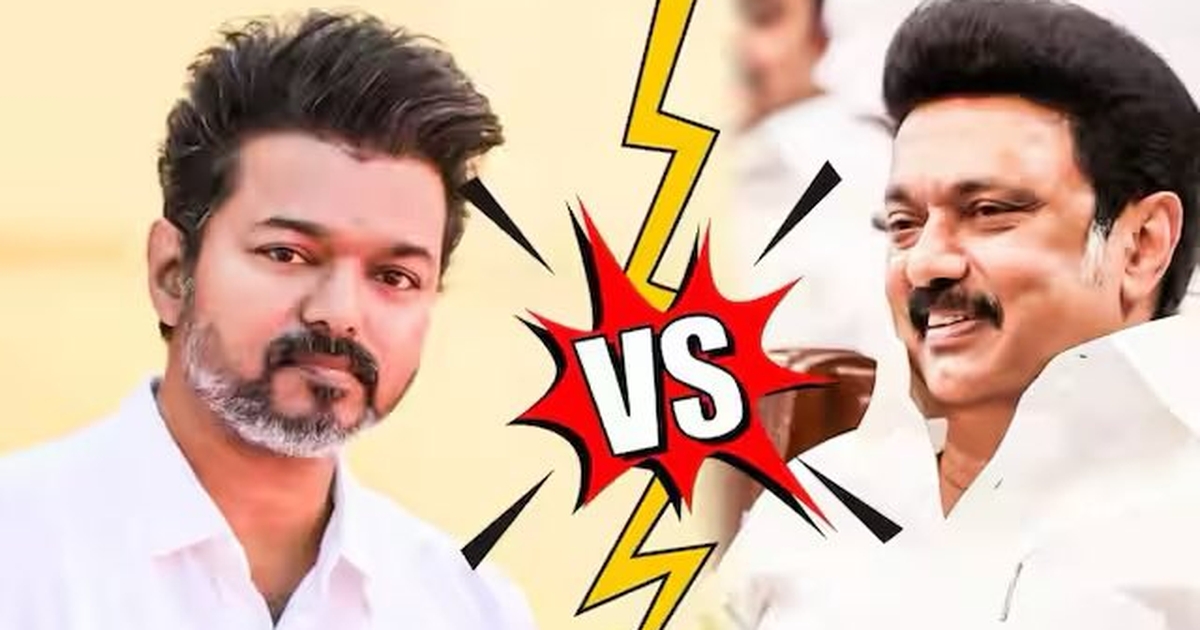
The TVK vs DMK 2026 political battle has quickly become one of the most talked-about stories in Tamil Nadu politics as the state gears up for the assembly elections in May 2026. The rivalry is more than just a clash between two parties; it reflects a shifting landscape where new voices and established powerhouses are competing for the hearts and minds of voters in India’s southern state.
At the center of this dynamic is Vijay, the actor-turned-politician leading Tamilaga Vettri Kazhagam (TVK). His party has been gaining unexpected momentum among youth and grassroots supporters, prompting major conversations about its role in the TVK vs DMK 2026 contest.
Meanwhile, the ruling Dravida Munnetra Kazhagam (DMK) under M. K. Stalin continues to maintain strength through a well-organised political base and welfare initiatives, setting the stage for an intense showdown.
In this article, we break down the evolving dynamics of the TVK vs DMK 2026 battle including party strategies, public sentiment, controversies, and what this means for the future of Tamil Nadu politics.
Rising Force — How TVK Has Emerged on the Political Stage
When TVK was launched by Vijay ahead of the 2026 Tamil Nadu elections, many observers saw it as a surprising development in a state traditionally dominated by established Dravidian parties. However, over the past two years the party has steadily built momentum, especially among young voters and first-time participants in local politics.
TVK’s messaging has centered around promises of transparency, grassroots engagement, and giving a platform to voices outside the political establishment, a contrast to the long political history of the DMK. The appeal of a fresh political alternative resonates with many who feel the need for new leadership and options in governance.
The rise of TVK has already altered what was once considered a predictable election, making the TVK vs DMK 2026 debate more relevant than ever.
Organisational Moves — TVK Prepares for the Polls
In recent days, TVK has taken significant organisational steps to strengthen its campaign for the upcoming elections. Vijay has appointed election observers across Tamil Nadu and the union territory of Puducherry to ensure coordinated outreach and district-level activities. Key leaders like N. Anand, K.A. Sengottaiyan, and Aadhav Arjuna will be responsible for supervising election preparations.
This demonstrates the seriousness with which TVK is approaching the poll battle not just as a political newcomer, but as a structured force seeking to influence outcomes across the state.
TVK leaders have also repeatedly ruled out alliances with some national parties, including the BJP, identifying ideological differences and presenting themselves as an independent alternative.
Government Strategies — How DMK Is Responding
On the other side of the TVK vs DMK 2026 battle, the DMK has not been idle. Chief Minister M.K. Stalin and the party leadership have continued to promote a series of welfare schemes and public engagement strategies that have formed the backbone of their governance narrative. Recent statements reaffirmed the party’s resilience against political pressure and highlighted achievements in social welfare programs.
Additionally, the DMK has formed committees to negotiate seat sharing with ally parties, an important tactical move to secure broader coalition strength as the election nears.
These efforts demonstrate the DMK’s intent to retain its position and counter the rising popularity of TVK and other parties in the state.
Public Sentiment — What Voters Are Saying Ahead of Polls
In the wider public discourse, reactions to the TVK vs DMK 2026 battle vary across demographics and regions. Some online discussions emphasize the potential disruption TVK could bring to traditional politics, while others point out the longstanding organisational strength and experience of the DMK.
A recent survey conducted by a local weekly indicated that while the DMK-led alliance (DMK+) continues to lead overall vote share projections, TVK has emerged as a favourite among certain segments, particularly the youth. This trend has added fuel to political discussions and raised questions about vote splitting and strategic alliances.
Such controversies add another dimension to the political narrative, showing both the challenges the party faces and its determination to continue moving forward despite criticism.
Controversies and Challenges — TVK’s Road Hasn’t Been Smooth
While TVK’s rise has been remarkable, it has not been without challenges. An income tax penalty was upheld against Vijay by the Madras High Court, which adds a layer of controversy to his political journey.
Additionally, the party has faced criticism and pressure tactics from rival factions, which TVK leaders have publicly rejected. Leaders have accused some government forces of exerting pressure and creating obstacles for their outreach events, framing it as anxiety among established parties about TVK’s growing momentum.
Such controversies add another layer to the ongoing political narrative, highlighting both the resistance the party faces and its determination to move forward despite criticism.
TVK vs DMK — What the Alliances Look Like
Alliance strategies play a major role in Tamil Nadu politics, and the TVK vs DMK 2026 battle is no exception.
While TVK continues to strengthen independently, DMK is actively negotiating with other parties to consolidate its position. These negotiations are seen as crucial for forming a strong front against competitors and preventing vote fragmentation.
The nature of these alliances could ultimately shape not just seat tallies but the political narrative itself determining which issues dominate voter attention and how campaigns are run leading up to the election.
Election Math — Can TVK Really Challenge DMK?
Analysts have debated whether TVK can genuinely mount a challenge to the well-established DMK machine.
According to some surveys, the DMK alliance still commands a solid lead in many voter segments. Yet TVK’s unexpected surge among specific groups, especially younger voters, suggests that the traditional political equation in Tamil Nadu may be shifting slightly even if not dramatically.
A key factor will be how TVK converts public interest into actual votes and how DMK retains its core support base while countering the narratives posed by TVK and other parties.
Impact on Regional Politics — Beyond TVK and DMK
This political contest is not happening in isolation. Other regional parties, national alliances, and independent candidates will also play a role in shaping how the overall political landscape develops.
The presence of TVK has already made some voters reconsider traditional party loyalties and sparked discussions about alternatives to established Dravidian politics. This impact extends beyond a simple two-party duel, bringing multiple voices into the electoral conversation.
This evolving scenario makes the 2026 elections one of the most unpredictable in recent Tamil Nadu history.
Final Thoughts — Why the 2026 Elections Matter
The TVK vs DMK 2026 contest offers more than a simple comparison of political parties; it is a reflection of changing public expectations, generational shifts in political awareness, and a dynamic interplay between new entrants and seasoned political forces.
Whether TVK continues to rise or the DMK consolidates power, the election will mark an important chapter in Tamil Nadu’s political discourse, one that voters, supporters, and analysts alike will watch closely.
Source
Compiled from verified news reports including The New Indian Express, The Times of India, and current political updates.
Written by Gowrisri | NewsNarada